
River Cruise Water Levels in Europe: Should You Still Go?

Updated: Aug 30
*Updated August 2026
If you have been watching the recent headlines about low water levels on the Danube and Rhine, you may be wondering whether a European river cruise is still a good idea. It is a fair question.
Water levels are creating real challenges in parts of Europe this summer. Some travelers have faced changed embarkation points, missed stops, longer bus rides, ship swaps, and canceled sailings. That does not mean every river cruise is unsafe or that every itinerary will be disrupted. It does mean travelers should understand what could change before they decide how comfortable they are moving forward.

What Is Happening With Europe’s Rivers Right Now?
Prolonged heat and drought have pushed parts of the Danube and Rhine to unusually low levels in 2026. In late July, the Associated Press reported record-low conditions on the Danube near Budapest, affecting both tourism and commercial traffic.
At one point, a Viking-operated ship also ran aground on a shallow stretch of the Danube near Bulgaria. All 186 passengers were evacuated, and no injuries were reported. That incident understandably attracted attention. It also showed why cruise lines monitor the rivers closely and make operational changes when a section cannot be navigated as planned.
Conditions can change from one stretch of river to another. They can also change from week to week. A water-level report from Budapest today cannot tell us exactly what will happen on a Rhine sailing next month.

What Low Water Can Actually Mean for Your Cruise
Most low-water disruptions are logistical rather than dramatic. A cruise line may:
Move the embarkation or disembarkation point
Replace a port with another destination
Use motorcoaches to reach an excursion
Transfer guests to a sister ship beyond a shallow section
Add a hotel stay if the ship cannot continue
Cancel a departure when other options are not workable
Some changes are fairly minor. Others can affect the part of the trip you were most excited about.
I recently had clients on the Danube who could not board their ship in Budapest as planned. Instead, they traveled approximately 60 miles to another port. The following day, they used bus transportation to return to Budapest for their excursions.
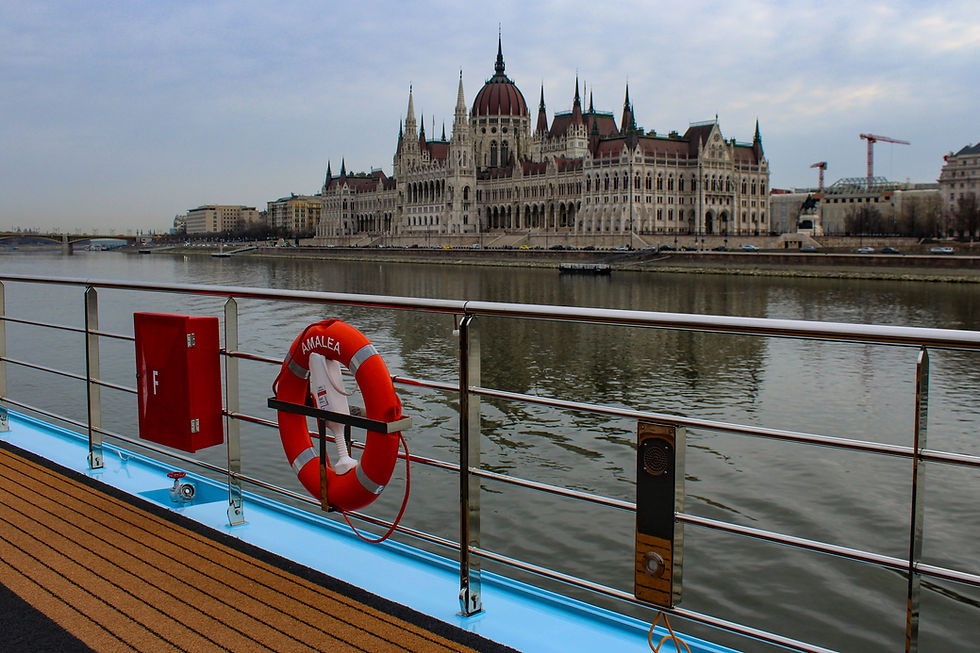
They still visited the city, but the experience was different. As I shared with The Independent, sailing into and docking in the heart of these grand cities is an important part of a river cruise. That is one of those details that is easy to overlook. Seeing Budapest after a long bus ride is not quite the same as stepping off the ship and finding the city waiting outside.

Are River Cruises Still Safe During Low Water?
Low water is usually more of a navigation and itinerary problem than a passenger-safety problem.
When a section of river cannot be navigated safely, the captain and cruise line may change the route, stop the ship, or move guests another way. That decision can keep travelers safe while still creating a disappointing change to the vacation. In other words, “safe” and “unchanged” are not the same thing.
A cruise can operate safely and still include more time on a bus. A sailing can be canceled because the line cannot navigate the route safely or deliver a reasonable alternative. One affected stretch does not mean every ship on every European river is facing the same problem.
Should You Still Book a European River Cruise?
Yes! I am not telling everyone to avoid Europe or stop considering summer river cruises. I am encouraging people to book with realistic expectations.
River cruising is still a comfortable and convenient way to see several destinations without changing hotels every night. But the river is part of the transportation system, and no cruise line can control the weather.
The better question is this: Would you still enjoy the trip if one part of the cruise became a bus journey, a different port, or a ship swap?
Some travelers would be disappointed but adapt easily. Others chose a river cruise specifically because they do not want long motorcoach days or hotel changes. Neither response is wrong.
If scenic sailing through a particular stretch of the Rhine or arriving by ship in Budapest is central to your trip, that matters quite a bit. If you care more about seeing the destinations and are comfortable with some flexibility, the risk may feel more manageable.

Does the Cruise Line Make a Difference?
It can. Cruise lines with larger fleets may have more options when a ship swap is needed. AmaWaterways and Viking, for example, operate multiple ships on popular European routes. That can be helpful if a compatible sister ship is already positioned beyond the affected section.
But fleet size is not a guarantee. The right ship has to be in the right place, and the itinerary still has to work around local conditions.
This is why I look beyond the brochure when helping clients compare river cruises. I want to understand not only what the planned itinerary looks like, but also how the cruise line communicates and responds when the plan has to change.
Can You Avoid Water-Level Problems by Choosing the Right Month?
There is no completely risk-free month. Low water is often associated with long periods of heat and limited rain. High water can also affect sailing schedules, bridge clearance, and docking during wetter periods.
Season should certainly be part of the conversation, but I would not choose your entire trip around a promise that the river will behave a certain way. I would also consider temperatures, crowds, mobility, airfare, the destinations you most want to see, and how flexible your travel dates are.
No honest advisor can predict a river fourteen months in advance.

What I Would Ask Before Booking
Ask a few practical questions:
How does this cruise line usually handle low-water disruptions?
Could this itinerary use a sister-ship swap?
Which part of the route is most sensitive to changing conditions?
What could happen to independently booked flights or hotel stays if the embarkation point changes?
What do the booking terms say about itinerary substitutions?
What would your travel insurance cover if the trip changes?
Would everyone in your party be comfortable with a longer bus ride or an unexpected transfer?
Travel insurance deserves a careful conversation. Do not assume a policy covers a missed port or an itinerary change simply because it includes “trip interruption” or “cruise coverage.” Ask for an explanation based on the specific policy you are considering.
What If Your River Cruise Is Already Booked?
If your departure is approaching, focus on your sailing rather than every headline.
Watch for direct updates from your cruise line or travel advisor. Confirm your embarkation point before leaving home. Keep your flight, hotel, and transfer information easy to reach. If you have mobility concerns, discuss them before an alternate transfer is announced.
And try not to let one gauge reading determine how you feel about the entire trip. Cruise lines make decisions using information about the ship, the navigation channel, local restrictions, and the full route, not just one number from one city.

My Honest Take
River cruising is still a great choice for many travelers. It is simply not a weather-proof vacation.
My job is not to frighten you away from a river cruise or promise that everything will operate exactly as printed. It is to help you understand the possibilities, choose a cruise line and itinerary thoughtfully, and make sure you have support if plans change.
I recently shared this same approach with Travel Weekly: good planning begins with honest expectations. Travelers may not be able to control the river, but they can avoid being blindsided by the ways a cruise might adapt.
If you are considering a European river cruise and want a second set of eyes on the itinerary, dates, and cruise line, send me what you are looking at. I would be happy to help you think through the tradeoffs without overcomplicating the decision.
If you are still early in your research, my free Smooth Sailing guide is an easy place to begin.

Let's Plan Your River Cruise
My planning services are completely complimentary, and your pricing is the same whether you book directly with the cruise line or work with me. The difference is having an experienced river cruise advisor helping you think through the details before anything is finalized.
If you would like help navigating the process of planning an amazing river cruise, I would be happy to talk through your options. I work with river cruise lines like AmaWaterways, Viking, Avalon, Tauck, and Uniworld every day, and over time you start to notice patterns that are difficult to see when you are simply comparing itineraries online for the first time.
When You Reach Out
We typically schedule a phone conversation within 24-48 hours
I help narrow down the strongest-fit options quickly
You receive personalized recommendations within 4-5 days
And many travelers are comfortably booked within 1-2 weeks from their first inquiry
My clients tell me they feel significantly more clear and confident after a quick conversation, even if they are still deciding. You do not need to have everything figured out before reaching out. That is exactly what I am here to help with and it would be my delight to support your travel.
📌 Take my River Cruise Personality Quiz to discover your travel style.
📌 Fill out an inquiry form and let's set up a time to talk!

Emma Guse is a River Cruise Specialist with Travelmation, helping solo travelers, couples, families, and groups plan unforgettable river cruises with ease. Known for her down-to-earth style and expert guidance, she handles the details so you can focus on making memories. Her river cruise insights have been featured in Forbes, Travel + Leisure, Travel Weekly, Yahoo News, The Independent, and other national publications. Emma's services are 100% complimentary and included in the base rates of every river cruise line. Learn more about Emma HERE or submit an inquiry HERE.

Comments